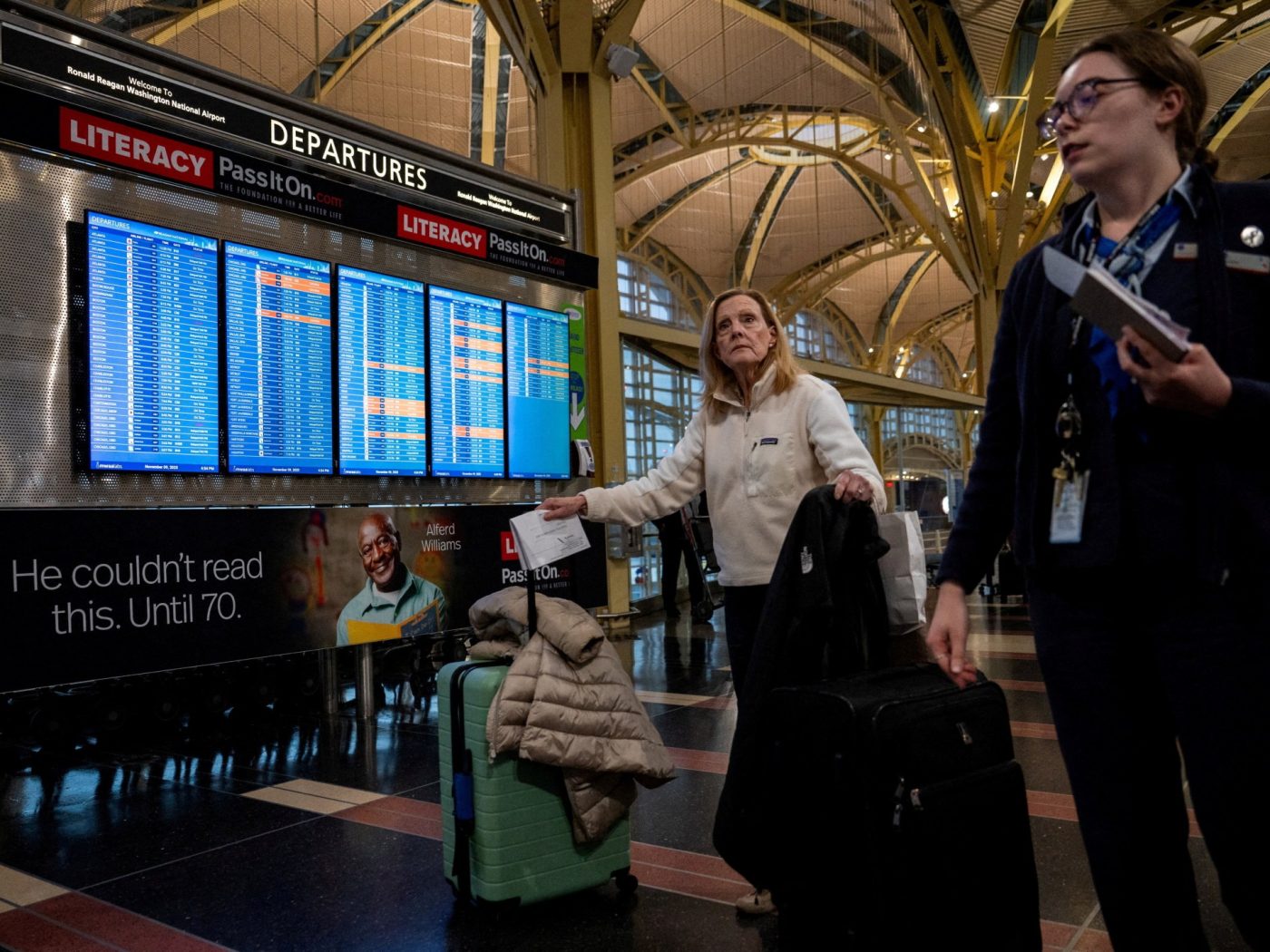

Even as Senate signals suggested the government shutdown might be close to ending, flight cancellations and delays kept piling up across the United States. Flight tracking service FlightAware reported that on Thursday average delays were 1 hour 16 minutes at New York’s LaGuardia, 44 minutes at Chicago O’Hare and 46 minutes at Las Vegas Harry Reid. That same day the platform logged at least 1,700 cancellations and more than 5,000 delays affecting domestic and international flights.
Airlines reported large numbers of affected passengers. American Airlines said weekend cancellations disrupted travel for roughly 250,000 customers. Airlines for America, the trade group representing major carriers, said staffing shortfalls tied to the shutdown have affected more than four million travelers since October 1.
The Federal Aviation Administration has ordered carriers to reduce daily flights at 40 major airports, citing air traffic control safety concerns. The cuts began at 4 percent last week, are set to increase to 6 percent on Tuesday and to reach 10 percent by November 14.
Air traffic control staffing has been under severe strain. President Donald Trump urged controllers to return to work and warned that pay would be docked for those who did not report, while also promising financial rewards for those who stayed on the job, including a pledge of $10,000 to controllers who showed up though he did not specify where the money would come from. FAA administrator Bryan Bedford said that since the shutdown started, between 20 and 40 percent of controllers at the 30 largest airports were not reporting for duty on any given day. Transportation Secretary Sean Duffy added that staffing worsened over the weekend, calling Saturday the worst day since the shutdown began.
To protect commercial flight capacity, the FAA announced a suspension of general aviation operations at 12 major airports, including Reagan National (but not Dulles), Chicago O’Hare (but not Midway), Houston George Bush Intercontinental (but not Hobby), Denver, Seattle and Boston. The move expanded a prior directive that had limited general aviation at designated High Impact Airports by as much as 10 percent.
Advocates pressed for stronger steps to free up runway and controller capacity, calling for limits on private jet travel. Erica Payne, president of Patriotic Millionaires, urged authorities to close top private aviation facilities near busy commercial hubs, saying that grounding private jets would quickly create the needed capacity.
When Al Jazeera asked the Department of Transportation for a timeline and plan to restore normal operations once the shutdown ends, the agency did not provide a clear roadmap. Instead, it supplied links, social posts and videos that placed blame on Democrats and cited controller shortages without outlining concrete logistics.
Markets showed some reaction to the disruption. As of 2:30 p.m. in New York (19:30 GMT) airline stocks had moved: American Airlines shares were down more than 2 percent since the opening, United off about 0.3 percent, Alaska down over 0.7 percent, JetBlue down about 0.5 percent, Delta roughly flat and Southwest up around 0.4 percent.