EXPLAINER
As the war enters its fourth week, here’s the latest on the US-Israel attack on Iran and across the Middle East.
The war launched by the United States and Israel on Iran has entered its fourth week, with more than 1,400 people reported killed in Iran.
Iran has attacked Israel and US bases in retaliation, threatened Western countries and Gulf states, and warned that global shipping and energy infrastructure could be at risk, as millions of Iranians mark Eid al-Fitr and Nowruz under the shadow of war.
Separately, the US said it was considering “winding down” the conflict while ruling out a ceasefire, and the United Kingdom has allowed the US to use military bases to carry out attacks on Iranian missile sites.
In Iran
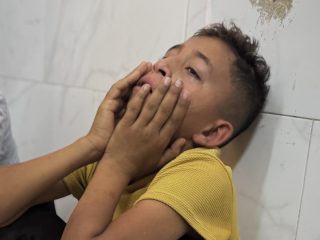
– Casualties: The war has killed 1,444 people in Iran, including at least 204 children. Air defences were activated over the capital, Tehran, and nearby areas following reports of explosions as the country celebrated the first day of the Persian new year, Nowruz.
– United Kingdom: Iran fired two ballistic missiles at the US-UK military base Diego Garcia in the Indian Ocean, the semi-official Mehr news agency reported. Iran’s foreign minister said Iran will “exercise its right to self-defence” and warned British lives were in danger after the UK allowed the US to use its bases to launch strikes on Iranian targets.
– 70th wave of attacks: The Iranian armed forces announced their 70th wave of attacks, launching missiles and drones towards Israel and US bases in the Gulf. Iran has stepped up attacks on energy sites across Gulf Arab states in retaliation for an Israeli strike on Iran’s South Pars gasfield.
– Holidays marked amid war: Millions of Iranians observed a rare alignment of Eid al-Fitr and Nowruz amid the threat of bombardment. Large crowds gathered at holy sites, including the Imam Reza Shrine in Mashhad, with many gatherings turning into anti-Western protests.
In the Gulf
– Direct threats to the UAE: Iran’s military warned it would deliver “crushing blows” to Ras al-Khaimah if there is any further aggression launched from UAE territory against the disputed islands of Abu Musa and Greater Tunb.
– Bahrain under fire: Bahrain’s defence forces said they intercepted and destroyed two more missiles fired from Iran, bringing their tally to 143 missiles and 242 drones destroyed since the attacks began on February 28.
– Saudi Arabia: The Saudi Ministry of Defense reported intercepting and destroying a large barrage of drones over its eastern region, saying at least 47 drones were shot down, including 38 in a concentrated three-hour attack.
– Kuwait: Kuwait’s Ministry of Defence said it was “dealing with hostile missile and drone attacks.” Two waves of Iranian drones struck the Mina al-Ahmadi refinery early Friday, sparking a fire at one of the Middle East’s largest facilities (capacity ~730,000 barrels per day).
– Qatar condemns Israeli strikes: Qatar’s foreign ministry strongly condemned an Israeli attack on military facilities in southern Syria as a violation of sovereignty and international law.
In the US
– Trump hints at winddown: US President Donald Trump said he was considering “winding down” military operations against Iran and that the Strait of Hormuz would need to be “guarded and policed” by other countries that use the waterway. He ruled out a ceasefire with Iran.
– Kharg island: Reports say Washington is considering plans to blockade or occupy Iran’s Kharg island, a strategic oil hub—a move that could cripple Iran’s economy but risks major escalation.
– More US Marines: The US is reportedly deploying an additional 2,200 to 2,500 Marines to the Middle East.
– Potential for US ground troops: Journalists and analysts say recent US military movements could lead to “boots on the ground” in Iran to secure the Strait of Hormuz.
In Israel
– Widespread damage: Israeli authorities said Iran fired nine separate salvoes of missiles at Israel. Israeli air defences are operating to intercept incoming fire, but falling debris and cluster munitions have caused widespread damage across central and northern Israel and the western Dead Sea area.
– Shelter disparities: Palestinian citizens of Israel have demanded better protection against missiles and drones, noting they do not have the same level of shelter access as other residents.
In occupied Palestine
– Al-Aqsa Mosque: Missile fragments fell in occupied East Jerusalem about 350 metres from the Al-Aqsa Mosque compound, causing extensive damage to the religiously important site.
In Iraq, Lebanon, Syria
– Rising casualties in Lebanon: At least 1,001 people have been killed in Lebanon since Israel renewed widespread attacks, including at least 118 children, according to Lebanon’s health ministry.
– US forces attacked in Iraq: A US logistics support camp near Baghdad’s international airport was hit by rockets, with explosions reported in the area.
– Evacuation orders in Beirut: Israel has warned residents of several southern suburbs, including Haret Hreik, Ghobeiry and Hadath, to evacuate before strikes on Hezbollah infrastructure.
– Military attack in Syria: Israel said it hit military infrastructure in southern Syria in response to alleged attacks on Druze civilians in Suwayda. Qatar, Jordan and Egypt condemned the attack.
Oil and energy markets
– Economic fallout: Disruptions in the Gulf have pushed oil higher, with Brent crude at about $112.19 per barrel, stoking fears of prolonged supply disruptions and a global economic downturn.
– Shift in global shipping: The Panama Canal is operating at top capacity (36–38 vessels daily) amid increased demand for LNG tanker passages linked to the war.
– US lifts sanctions to counter rising costs: Washington lifted sanctions on Iranian oil already loaded on tankers to boost supply, but Tehran said it has no surplus crude to sell and dismissed the move as symbolic.
– The oil sanctions paradox: Analysts note the US decision to lift limited sanctions while prosecuting a war with Iran may be counterproductive to lowering prices.
– Critical maritime threats: The UK Maritime Trade Operations agency said the threat level across the Gulf, Strait of Hormuz and Gulf of Oman remains “critical,” citing 21 confirmed attacks on commercial vessels and offshore infrastructure since March 1.