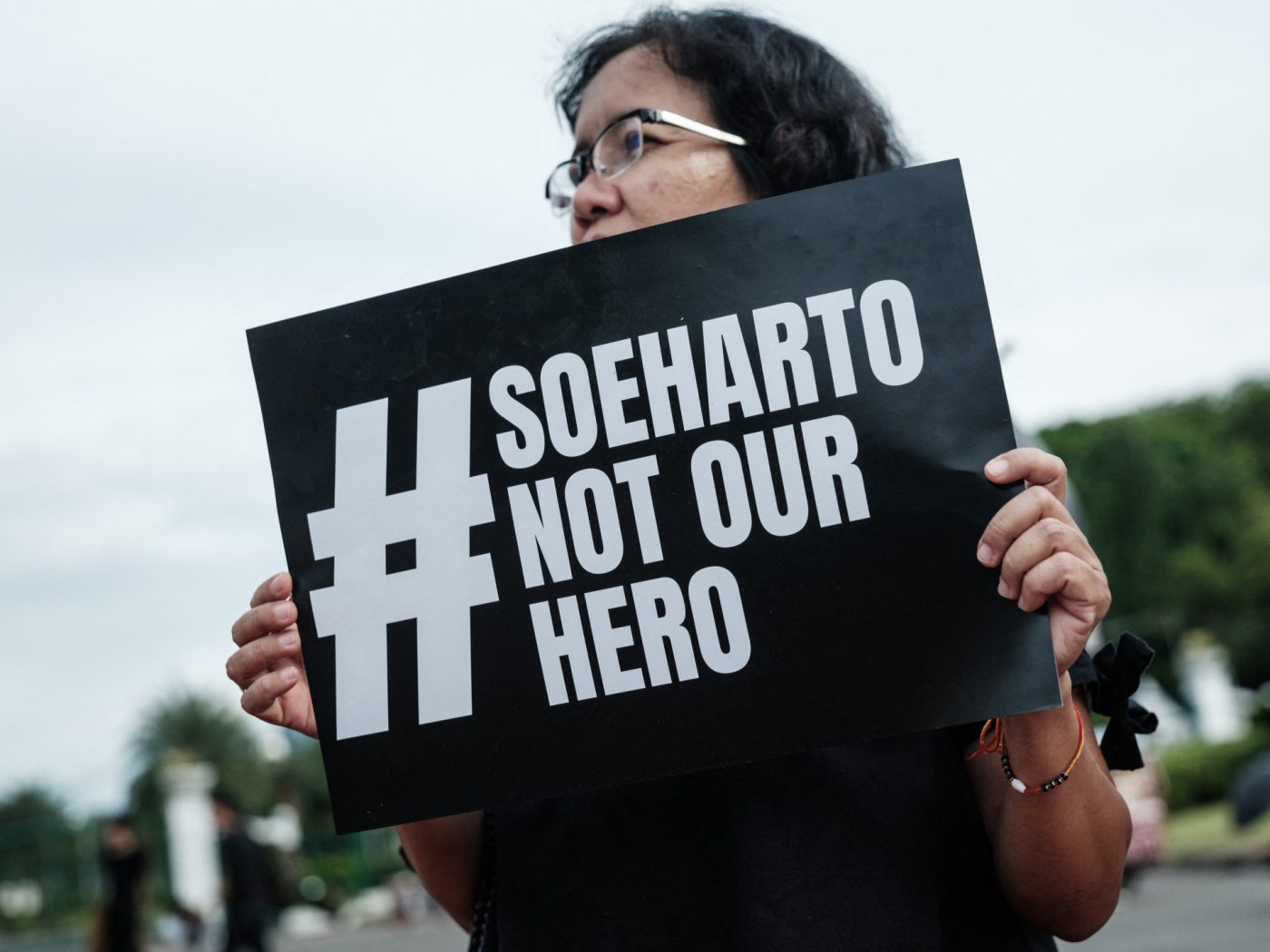

Indonesia’s former president Muhammad Soeharto, whose three-decade rule was long criticised for mass human rights abuses, was posthumously named a “national hero” in a ceremony led by President Prabowo Subianto. The decision prompted protests from pro-democracy activists and relatives of victims of Soeharto’s authoritarian era.
Soeharto, also spelled Suharto, was Indonesia’s second president and a career military officer who took power in 1967 after sidelining the country’s first president, Sukarno. He rose amid turmoil following a 1965 incident in which six military officers were killed; Soeharto launched a sweeping purge of alleged communists that resulted in the deaths of more than half a million people. His precise role in the events that led to the purge has never been fully established and the killings were never comprehensively investigated.
During his presidency Soeharto used the military to dominate civilian life, crushed dissent, and oversaw a long occupation of East Timor from 1975, during which hundreds of thousands are estimated to have died. He enjoyed Western support—particularly from the United States—during the Cold War because of his staunch anti-communism. Declassified US documents show Washington had detailed knowledge of the 1965 campaign against alleged communists.
Soeharto’s rule brought rapid economic growth and relative political stability, but it was also marked by severe restrictions on freedom of speech and persistent allegations of corruption and nepotism benefiting his family and cronies. Attempts to prosecute him for graft after his 1998 removal failed: he did not appear in court and was later declared too ill to stand trial.
He was forced from office in 1998 amid mass student-led protests triggered by the Asian financial crisis. After stepping down he issued a general apology to the nation but did not explicitly address the abuses and wrongdoing attributed to his government. Soeharto came from a modest background, joining the Dutch colonial army as a young man and later fighting with Indonesian guerrillas against colonial forces after Indonesia declared independence in 1945.
The national hero designation was one of ten recognitions announced during a televised ceremony at the presidential palace in Jakarta to mark National Hero Day. During the event, an announcer described Soeharto as “a prominent figure from Central Java, a hero of the struggle for independence.” His daughter Siti Hardiyanti Rukmana and son Bambang Trihatmodjo received the honour on his behalf; Siti urged people to remember her father’s lifelong contributions.
The move drew sharp criticism. Activists and civil society groups rallied outside the palace ahead of the ceremony, warning of historical revisionism and accusing the government of whitewashing a violent past. Protesters carried signs such as “Stop the Whitewashing of the General of Butchery.” The Commission for the Disappeared and Victims of Violence (KontraS) called the designation immoral, saying someone suspected of involvement in serious human rights violations should not be glorified. Around 500 academics, activists and civil society members had written to President Prabowo urging him not to proceed, calling the honour a betrayal of victims and democratic values.
Defenders of the decision say the national hero process involves research and public input. Culture Minister Fadli Zon said candidates met the criteria and State Secretary Prasetyo Hadi framed the award as a way to honour predecessors who made notable contributions to the nation.
President Prabowo has personal and political ties to Soeharto. A former army general who led special forces under Soeharto, Prabowo was once married to Soeharto’s daughter Siti Hediati Hariyadi. Prabowo has faced accusations of involvement in military abuses in East Timor during the 1980s. Soeharto’s political vehicle, the Golkar party, remains influential and supported Prabowo’s rise. Critics contend Prabowo’s decision to grant the title reflects a broader trend of increasing military influence in civilian affairs.
The controversy highlights deep divisions in Indonesia’s memory of the past: some remember Soeharto for stability and economic development, while many others—survivors, victims’ families, human rights advocates and historians—view his legacy as one of repression, mass violence and entrenched corruption.