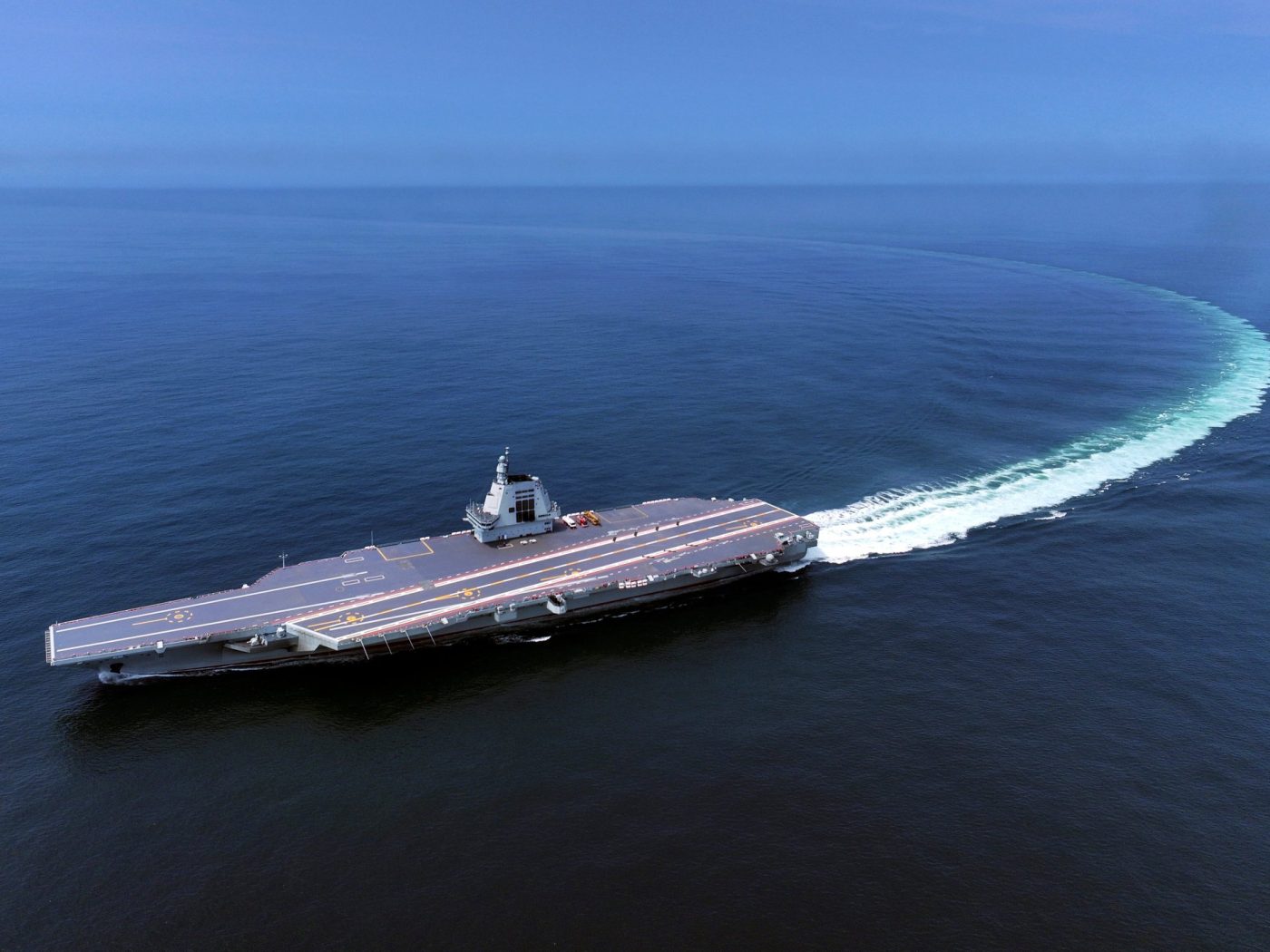

China’s third aircraft carrier, Fujian, has formally entered service after extended sea trials, state media said. President Xi Jinping inspected the ship at Sanya in Hainan province during a commissioning ceremony attended by more than 2,000 navy and shipbuilding representatives.
Fujian is the country’s first carrier designed and built domestically and represents a major technical leap from the earlier Liaoning and Shandong. Unlike those smaller, ski-jump–equipped ships, Fujian has a flat flight deck and electromagnetic catapults, similar to the U.S. Navy’s latest Ford-class carriers. That system allows it to launch heavier, better-armed fixed-wing aircraft and to carry more planes overall.
During trials the carrier launched China’s new carrier-capable J-35 stealth fighter, an early-warning KJ-600 aircraft, and a variant of the J-15. The ability to operate an onboard early-warning platform means Fujian can conduct carrier strike operations farther from land-based support and maintain situational awareness at greater distances than its predecessors.
How quickly Fujian will reach full combat readiness remains unclear, but analysts say the ship is a visible example of President Xi’s rapid military modernization. Xi has set targets for a modernized Chinese military by 2035 and a ‘‘world-class’’ force by 2050, and the carrier moves Beijing toward those goals.
Greg Poling of the Center for Strategic and International Studies’ Asia Maritime Transparency Initiative described carriers as central to Chinese leaders’ vision of a blue-water navy. While such a vessel has limited utility within the so-called First Island Chain — the South China Sea, East China Sea and surrounding waters — it is important for projecting power and contesting U.S. influence farther into the wider Indo-Pacific.
Fujian’s commissioning marks a significant step in China’s naval expansion and enhances Beijing’s ability to operate larger, more capable carrier strike groups at greater range.