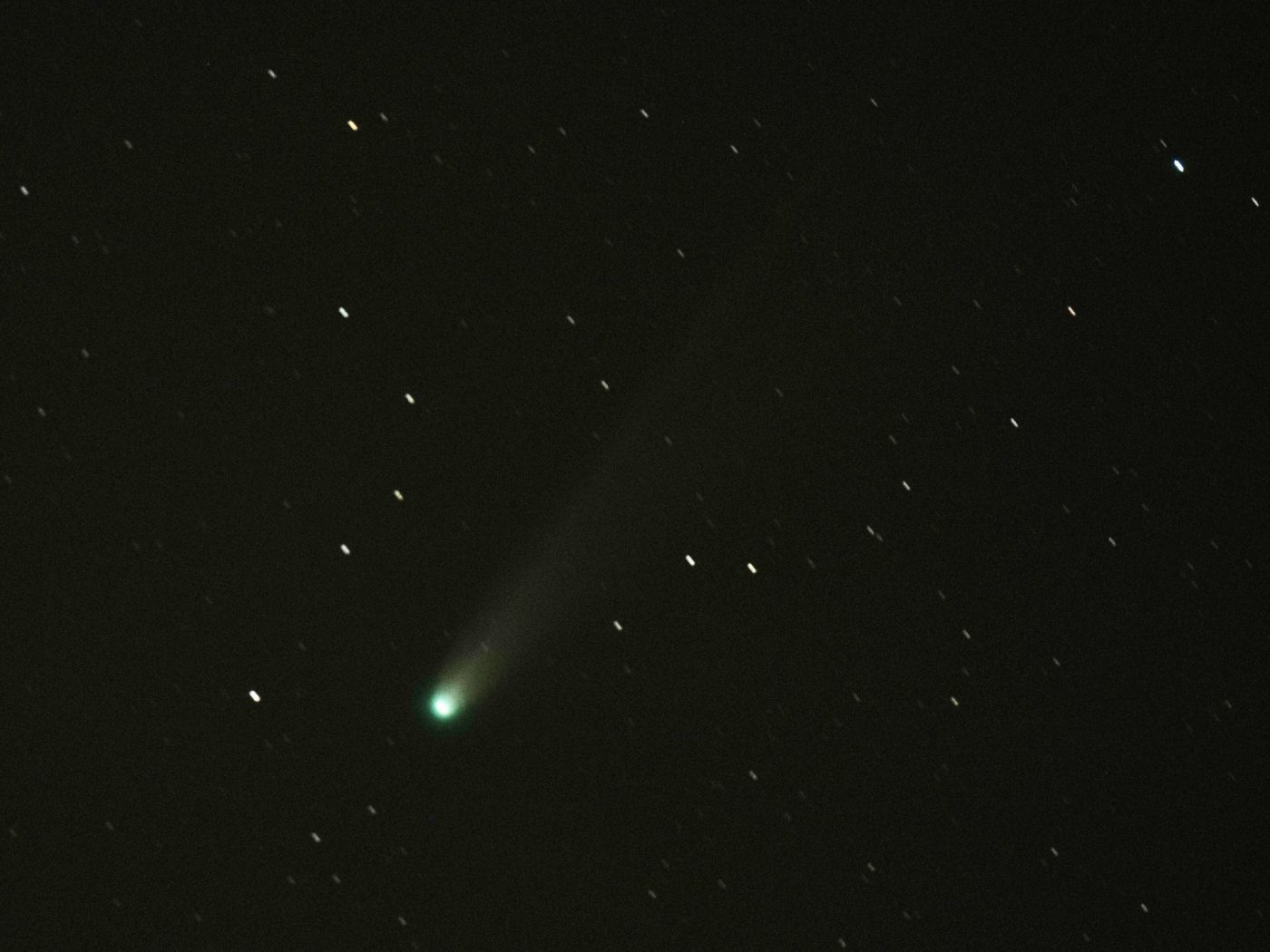

Astrophysicists around the world are urgently observing an ancient object that arrived in our solar system from another star. Designated 3I/ATLAS, the visitor is not a danger to Earth or nearby planets, but it has generated intense interest because it is only the third confirmed interstellar object ever detected.
What 3I/ATLAS is
3I/ATLAS is an interstellar comet — a body of ice, dust and gas that formed around another star and is passing through our solar system on a hyperbolic trajectory, meaning it will not remain bound to the Sun. Comets are primitive remnants of planet formation, so an interstellar example offers a rare chance to sample material from another planetary system.
Discovery and context
The object was first identified in July by Larry Dennau and the ATLAS (Asteroid Terrestrial-impact Last Alert System) team at their telescope in Rio Hurtado, Chile. ATLAS is funded by NASA and run by the University of Hawai‘i’s Institute for Astronomy. The letter “I” in its designation marks it as interstellar, joining only two predecessors: 1I/’Oumuamua, a cigar-shaped object discovered in October 2017 by Robert Weryk using Pan-STARRS in Hawaii, and 2I/Borisov, a clearly cometary interstellar object found in August 2019 by Gennadiy Borisov.
Where it has been and where it’s going
3I/ATLAS passed within about 29 million km (18 million miles) of Mars in October, traveling at roughly 310,000 km/h (193,000 mph). It reached perihelion — its closest approach to the Sun — at the end of October, and is expected to make its nearest apparent approach to Earth in December, at an estimated distance of about 270 million km (170 million miles), still well beyond Earth’s orbit.
Because its path carries it behind the Sun from Earth’s viewpoint for a time, the object is temporarily unobservable from the ground; NASA estimates it will reappear on the far side of the Sun by early December 2025.
Who is watching it and why
A broad set of telescopes and spacecraft have been directed to observe 3I/ATLAS to learn its size, composition and structure. In addition to the Hubble Space Telescope, instruments and missions contributing observations include the Mars rovers Perseverance and Curiosity, the Mars Reconnaissance Orbiter, the Parker Solar Probe, SOHO (the Solar and Heliospheric Observatory) at the Sun–Earth L1 point, and newer solar missions such as PUNCH (the four small spacecraft launched in March 2025). ESA missions including Juice (bound for Jupiter) and other deep-space probes like Lucy and Psyche are also monitoring the object where their geometry allows.
Scientists want to know whether interstellar comets resemble objects formed in our own system or whether they show different chemistry and structure. Studying an interstellar comet helps test models of planet formation and the diversity of planetary systems.
What observations have revealed so far
Multiple observatories have confirmed that 3I/ATLAS is cometary: its orbit is hyperbolic, and telescopes have captured a coma and dust tail. Hubble images from July showed a teardrop-shaped envelope of dust emanating from an icy nucleus. Estimates of the nucleus size range from perhaps a few hundred meters to several kilometers across — Hubble observations place an upper limit near 5.6 km (3.5 miles) and a possible lower bound around 440 meters (1,444 feet).
Spectra and other measurements indicate the coma is rich in carbon dioxide, which suggests the object formed in very cold environments far from its parent star. Planetary scientist Darryl Seligman has noted that such CO2-rich composition points to formation at large distance from a host star, where volatile ices can accumulate.
Why the rush matters
Interstellar visitors are extraordinarily rare; each one provides a unique window into materials and processes that produced planets and small bodies around other stars. Because 3I/ATLAS is only briefly observable as it passes through the inner solar system, astronomers are coordinating many facilities now to collect as much data as possible before the opportunity ends. Those measurements may reshape our understanding of how common certain ices and minerals are across the galaxy and help refine theories of how planetary systems form and evolve.